Texas Medical Center in Houston, Texas, Largest Medical complex
Author: Melinda Luna PE, CFM, F.ASCE
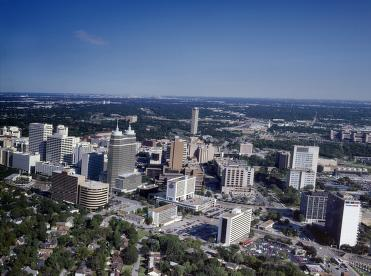
The Texas Medical Center (TMC) in Houston stands today as the largest medical complex in the world—a sprawling ecosystem of hospitals, research institutions, and academic centers that collectively redefine the boundaries of healthcare and innovation. Yet behind its world-renowned medical achievements lies an extraordinary feat of civil engineering. The transformation of a low-lying, flood-prone area into a global medical hub required decades of meticulous planning, infrastructure development, and engineering ingenuity.
Founded in 1945, the Texas Medical Center emerged from a vision to create a collaborative medical district that could serve both education and public health on a massive scale. The chosen site, south of downtown Houston along Brays Bayou, was far from ideal. The area’s natural conditions presented civil engineers with a substantial challenge: unstable soils, frequent flooding, and minimal infrastructure.
Before construction could even begin, engineers had to reimagine the land itself. Extensive soil stabilization projects transformed the swampy bayou terrain into solid ground capable of supporting multi-story hospitals and laboratories. Civil engineers implemented advanced grading and drainage techniques for the mid-20th century, strategically elevating key building sites and designing comprehensive stormwater management systems.
Several civil engineers, contractors, and specialized designers played key roles in the early development and construction of the Texas Medical Center (TMC) in Houston during the 1940s and 1950s.
Key engineers responsible for the early infrastructure and construction of the Texas Medical Center include:
- Herbert A. Kipp: A prominent civil engineer who served as the president of the River Oaks Corporation, Kipp was responsible for the layout of the subdivision that became the Texas Medical Center, as well as the plans for the adjacent Hermann Park.
- Warren Sylvanus Bellows: A pioneer civil engineer and founder of the W.S. Bellows Construction Corporation in Houston, Bellows was responsible for the construction of many major institutions within the TMC, including the early buildings in the 1940s and 1950s. The list of projects includes Texas A & M, University of Texas (included the UT Tower), San Jacinto Monument, Naval Air Station in Corpus Christi, University of Houston, Southern Methodist University, Hotels, Buildings, headquarters, throughout Texas and many bridges.
- Carl J. Eckhardt Jr.: A mechanical engineer who supervised the construction of the Main Building Tower (though heavily involved with UT Austin, his expertise was utilized in the early era of academic-hospital construction in Texas).
Flood Control: Engineering for Resilience
Flooding was the most persistent threat to the Texas Medical Center’s survival—and remains a core engineering focus to this day. Brays Bayou, which flows through the district, has historically overflowed during intense rainfall. In the 1970s and again in the 1990s, floods caused severe disruptions. Engineers and city planners responded with large-scale flood control projects, many led by the Harris County Flood Control District and the U.S. Army Corps of Engineers.
Projects such as Project Brays, initiated in the late 1990s, reshaped the bayou through channel widening, new bridges, and massive stormwater detention basins. Civil engineers applied hydrologic modeling to predict runoff behavior and optimize flood mitigation. These efforts have greatly reduced the risk of catastrophic flooding, protecting billions of dollars in infrastructure and ensuring the continuity of vital medical services.
Transportation and Connectivity
The success of the Texas Medical Center hinged not only on its buildings but also on its accessibility. Civil engineers have built a complex web of roads, pedestrian pathways, and transit options to connect the various institutions. The construction of Holcombe Boulevard, Main Street extensions, and later, the METRORail Red Line, integrated the center with the broader Houston metropolitan network.
Engineers prioritized efficient circulation to accommodate the center’s daily influx of tens of thousands of professionals, patients, and visitors. Underground service tunnels carrying utilities and connecting many of the buildings were another key achievement—reducing surface congestion, improving logistics, and ensuring uninterrupted operations during severe weather events.
Structural Foundations and Sustainability
Many of the Texas Medical Center’s signature structures—such as Houston Methodist Hospital’s research tower and the MD Anderson Cancer Center—rest on deep foundation systems designed to handle Houston’s soft clay soils. Engineers used reinforced concrete pilings and post-tensioned slabs to achieve structural stability. Over the decades, as the TMC expanded vertically, these foundations have supported increasingly taller and more complex buildings.
In recent years, sustainable civil engineering techniques have become integral to the TMC’s ongoing expansion plans. Engineers incorporate green infrastructure such as permeable pavements, green roofs, and rainwater harvesting systems to enhance stormwater management. The TMC^3 research campus, currently under development, exemplifies this shift toward resilience and sustainability—balancing innovation with environmental stewardship.
A Living Monument to Civil Engineering Excellence
Today, the Texas Medical Center encompasses more than 50 institutions across over 1,300 acres, employing more than 100,000 people. Its physical infrastructure—tunnels, flood channels, roadways, and utilities—represents generations of civil engineering expertise. The center’s continued growth demands innovative approaches to urban planning, transportation design, and climate adaptation.
The story of the Texas Medical Center is not only one of medical breakthroughs but also of engineering triumph. It should be a Civil Engineering landmark as it reflects how planning, adaptive design, and technological advancement can overcome environmental constraints to create a lasting foundation for progress. Through every storm and every decade of expansion, civil engineers have quietly worked on what is the world’s largest healing hub remains safe, resilient, and ready to serve.