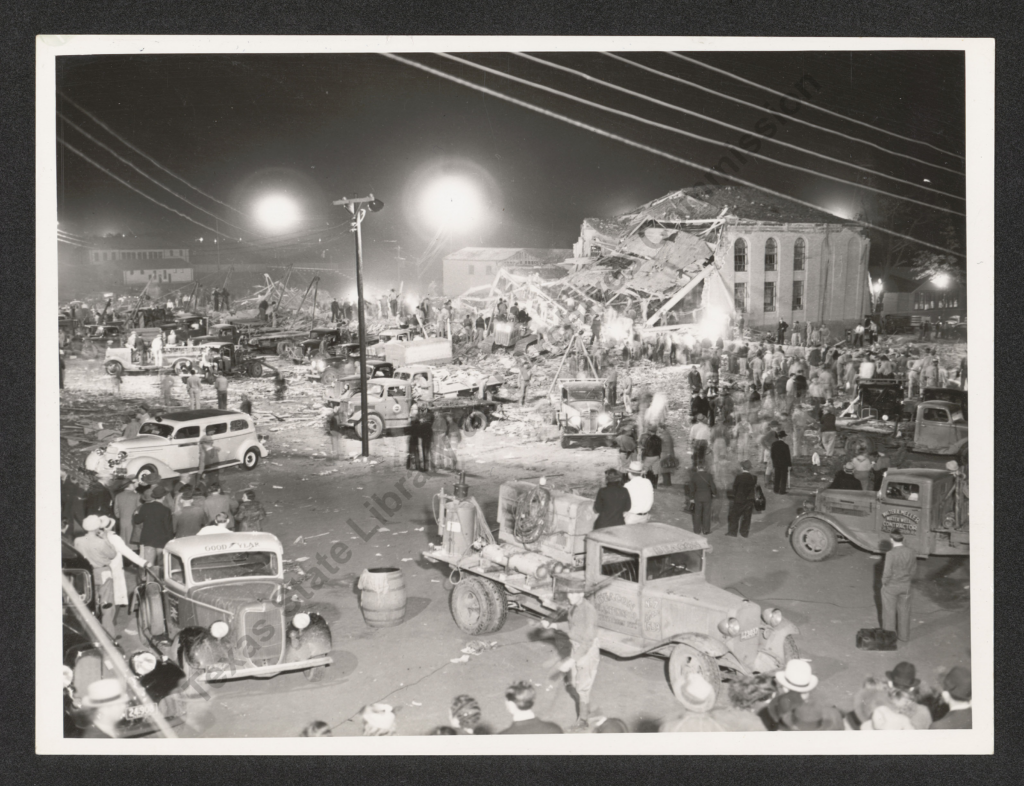
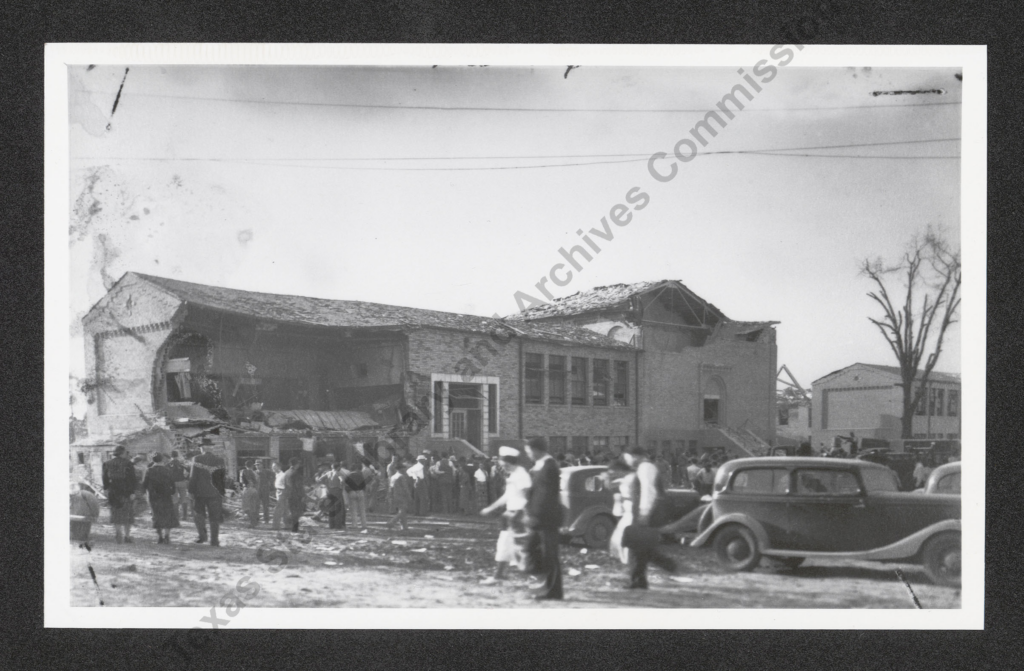
New London School Explosion
June 2026
Author: Angie Fealy PE
Each engineer has a deep personal reason for choosing this profession — fame, fortune, family tradition. Mine began with a story from 1937, one that shaped my family long before I was born.
In the mid‑1930s, during the Great Depression, the London, Texas school district remained one of the wealthiest in the country. In early 1937, the district canceled its natural gas contract and had a plumber tap into Parade Gasoline Company’s residue gas line to save $2.65 per year (about $38.47 in 2020 dollars). The line was unmetered and improperly tapped, and untreated natural gas, odorless and colorless, leaked silently into the school’s basement. At the time, tapping into free gas lines was common practice, and without odorization, leaks often went unnoticed. March 18, 1937, began like any ordinary school day. First through fourth graders were released early. Parents gathered for a PTA meeting in the gym. Fifth through twelfth graders waited for the 3:30 p.m. dismissal bell.
At 3:17 p.m., investigators believe that when a manual‑training instructor demonstrated an electric sander in the gas‑filled basement, the tool sparked and ignited the gas‑air mixture. The explosion that followed was heard four miles away. Nearly 300 students and teachers were killed, many beyond recognition except by their clothing. It remains one of the deadliest school disasters in Texas history.
In the aftermath, the Texas Legislature enacted the Texas Engineering Practice Act, establishing regulations of engineering practice in the state. Texas also became the first state to require that natural gas be mixed with an odorant, typically mercaptan (which smells like rotten eggs), to provide early warning of leaks, a safety measure still used today.
Two members of my family were students at New London that day. One was released early. The other wasn’t. My great‑uncle, James Patrick Fealy, was among the children who died. My grandfather, Michael Joseph Fealy, had been dismissed around 3:10 p.m. and remembered watching the school disappear in an instant. Learning this part of my family history left me with a mix of grief for the relatives I never met and anger that preventable negligence had shaped the course of my family forever. That loss became the foundation of my commitment to engineering. I wanted to ensure that no community would suffer because of unregulated work or overlooked safety standards.
Today, I work as a land development engineer‑in‑training on large‑scale federal aviation projects. I am in the process of earning my professional license and hope to complete it by the end of the year. Earlier this year, I visited New London. Standing on the site, I felt the weight of what happened there; the echoes of chaos, grief, and the silence that followed.