Jean-Louis Briaud Named 2026 Terzaghi Orator
August 2026
Author: Ricardo Peña
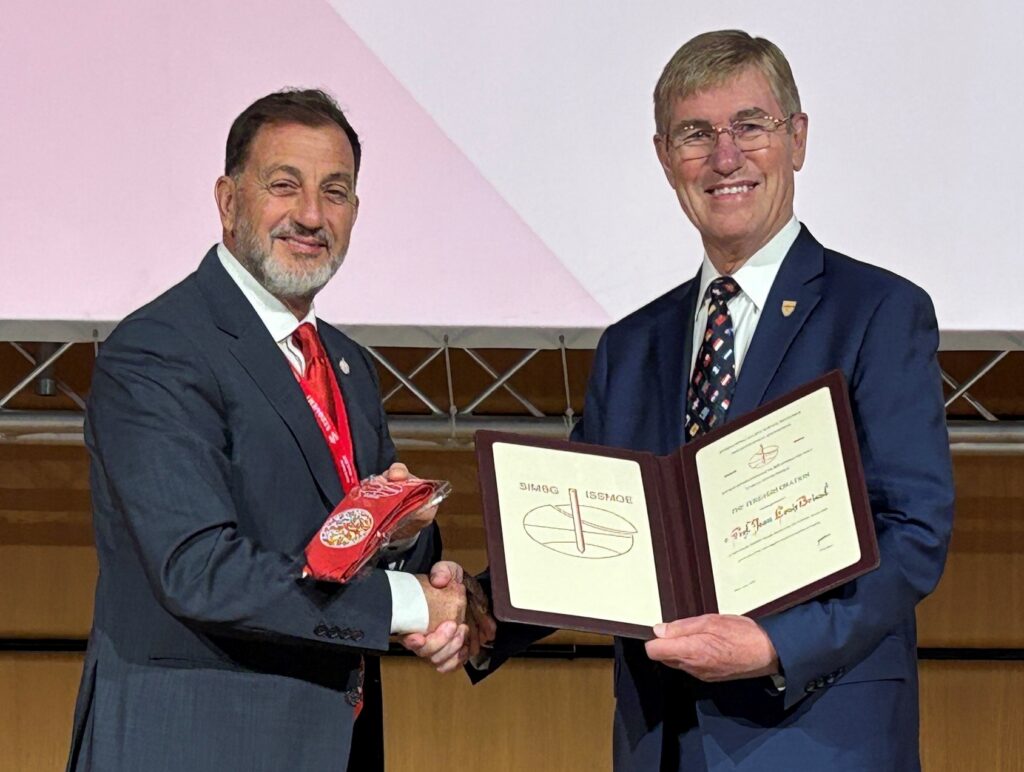
Jean-Louis Briaud, University Distinguished Professor of civil engineering at Texas A&M and a past president of the ASCE Texas Section, delivered the Terzaghi Oration at the 21st International Conference on Soil Mechanics and Geotechnical Engineering in Vienna in June 2026, one of the field’s most distinguished international honors.
For Briaud, the recognition capped 35 years of research at Texas A&M on a topic he says is chronically underestimated: soil erosion.
“It’s a major topic in geotechnical engineering, and it’s an underrepresented topic,” Briaud said. “But it’s a big problem. We’re talking about bridges over rivers that collapse, levees that breach, earth dams that leak.”
Turning Decades of Research Into Something Engineers Can Actually Use
Briaud described his Terzaghi Oration as something other than a comprehensive review of the field. Instead, it distilled decades of erosion research conducted at Texas A&M into a single, usable resource.
“I tried to present it in such a way that people, once they had that paper, would actually be able to solve problems,” he said.
The first half of the lecture covered the fundamentals of erosion, why water is such an effective erosive force, driven by turbulence, drag, and uplift. The second half moved into applications: bridges, levees, meanders, and even erosion on the Moon, where the high-speed gas expelled by spacecraft retrojets during landing can send fine lunar dust into astronaut suits and equipment sensors.
“It’s at the same time an introduction, a guide, a result of fancy research, but in the end, useful and simple,” Briaud said of the lecture.
That balance, rigorous research paired with practical payoff, has defined his approach to picking research problems throughout his career. Rather than chase crowded, well-funded topics, he has gravitated toward significant problems that draw less attention: erosion, in-situ testing, geothermal energy, roadside safety.
Why Texas A&M
Briaud was born, raised, and educated in France before pursuing his master’s and Ph.D. in Canada, a deliberate choice to see more of the world before starting a career. Afterward, he received offers from both consulting firms and universities, ultimately choosing Texas A&M.
What kept him there, he said, wasn’t the university alone, it was the people.
“The reason I stayed is the people,” Briaud said. “Texans in general, but A&M in particular, are extremely kind, and have a tremendous can-do attitude.”
Having lived in Paris and Ottawa before arriving in Texas, Briaud said College Station’s combination of small-town scale and a major research university was the right fit.
A Debt to the Profession
Briaud’s ties to ASCE run much deeper than a single award. He served as president of the ASCE Texas Section in 2020–2021, building on years of involvement and leadership within the organization. His path to the presidency was shaped in part by an issue he encountered while serving as president of the Geo-Institute. Rather than letting the challenge become a roadblock, Briaud approached it with determination and a willingness to find a way forward.
He weighs challenges against a simple test: Is this a problem worth the energy to fix, or one to accept and move past? This one, he decided, was worth pursuing. He continued to take on leadership responsibilities within ASCE, working his way through the organization and ultimately reaching the Texas Section presidency.
“I was driven by a problem I couldn’t solve as president of the institute,” he said.
That determination reflects Briaud’s broader approach to professional service: identify an opportunity for improvement, stay positive, and keep working toward a solution. His years of involvement with ASCE have allowed him not only to address individual challenges, but also to contribute to the organization and the profession through leadership and service.
A Father’s Assignment, and a Father’s Challenge
Briaud’s path into civil engineering, and eventually geotechnical engineering, began around his family’s kitchen table in France when he was 17. His father, a contractor, went around the table assigning careers: Jean-Louis would become a civil engineer, while his brother, Michel, would become a doctor.
Briaud followed his father’s suggestion and enrolled in civil engineering in Paris. It was only later that he discovered where his career would take him: geotechnical engineering. What initially began as an unexpected specialty became a field that kept him engaged for decades. He was drawn to the balance between fieldwork and computation, theory and testing, and the fact that every problem brought a new challenge.
“It’s a tremendously complex field, very difficult, and I never got bored,” Briaud said.
His father also helped shape the professional philosophy Briaud is best known for today. Years into his career, Briaud explained his research to his father, who listened patiently before asking a simple question: “So what?”
“From that point on, I said, whatever I do, I want to make sure my father cannot say, ‘So what?’”, Briaud said.
A few years later, a fellow geotechnical engineer gave Briaud the other half of that lesson, telling him his research was too complicated. Together, the two observations became a guiding principle: use whatever advanced tools a problem requires but take the extra time to make the solution simple enough for other engineers to understand and apply.
“If you can do useful and simple,” Briaud said, “I think your career will be much more rewarding.”
Repaying a Debt at Pointe du Hoc
Asked which project, among decades of research, awards, and patents, means the most to him, Briaud didn’t point to an award or a technical breakthrough. He pointed to the cliffs at Pointe du Hoc in Normandy, France, where American Rangers scaled 90-foot cliffs under fire on D-Day in 1944.
By the mid-2000s, erosion was threatening to send the historic bunkers and monuments at the site into the sea. U.S. Rep. Chet Edwards, whose district included College Station, secured federal funding for Texas A&M’s Center for Heritage Conservation to study the site, and Briaud, already known for his erosion work, was brought in to help stabilize the cliffs.
“I’m forever grateful to all these young Americans that sacrificed their lives to come deliver my parents,” Briaud said. His parents lived through the German occupation of France; the Allied soldiers who landed at Normandy made his own life, decades later, possible.
“We’ve benefited from a lot of the past generations,” he said, “and we pay it forward.”
Advice for the Next Generation
Asked what he’d tell engineers early and late in their careers, Briaud returned to a message he’s repeated for decades: “Go after your dreams with vision and perseverance.”
Vision, he clarified, means making sure the dream is one worth pursuing and perseverance doesn’t mean refusing to change course.
He offered one closing thought that has nothing to do with engineering at all, one he posted on his children’s bedroom doors so they’d see it every day.
“When everything else fails, remember that happiness is a choice,” Briaud said. “It’s easy to say and not easy to do, but you always have that choice.”
Links:
2026 Terzaghi Oration – ISSMGE
Soil erosion: From fundamentals to applications (The 2026 Terzaghi Oration) | ISSMGE