Houston’s McKee Street Bridge
An Engineering Marvel Stitched into the Fabric of Home
Author: Brian P. Alcott
He had been working on the calculations for hours. Days, it seemed. Scrap paper was strewn across the floor. The sticky heat in his office did nothing to ease his frustration. The City Hall building was fine enough, but the Houston heat was stifling, no matter how good the office. He could tell he was irritated because the smallest things bothered him more than usual. The intermittent ping of someone on his team hitting the spittoon. The ripe smell of horse manure drifted in from the street.
Still, he was proud of the engineering team he had built. The city’s office had developed a reputation for tackling complex designs with its own staff, a capability that had taken years to cultivate. Yet this problem might finally be their match. The previous design called for a steel superstructure, but the bids had come back far too high. There was simply no money in the budget. Now the public was outraged. Their one hope for a path forward had evaporated. But Joseph Gordon (J.G.) McKenzie knew there had to be a way. The city engineer was counting on him and on his team. He had analyzed the shear and moment diagrams a thousand times. A concrete beam would be the most economical solution, but the numbers refused to cooperate. He was exhausted. J.G. stared at the moment diagram, his eyes watering as he drifted into a sleepless daydream. Parabolas floated through his mind. And then an idea emerged from the mental ether.
Any engineer who has faced late nights trying to solve an impossible problem knows this moment well. The year was 1930, and this was the scene confronting the City of Houston’s bridge engineer, J. G. McKenzie. The problem before him seemed unsolvable. Yet the result would become a bridge unlike any other. McKenzie’s design for the McKee Street Bridge pushed the practice of bridge engineering into uncharted territory, advancing the field through long hours, frustration, and ultimately a great deal of grace and style.
The city engineer at the time reportedly said, “There is not another one like it anywhere,” and the president of the American Society of Civil Engineers is said to have exclaimed, “My God! That’s a beautiful design,”1 when he first saw it. Today, however, this engineering marvel sits quietly on the east side of Houston. Towering highways loom nearby, and overhead utility lines lace the air around it. The bridge itself remains structurally sound, yet few people give it a second look. Even young engineers in the profession may glance at it briefly and comment that it “looks interesting.” Such is often the fate of engineering marvels.
Over time, they become familiar. What was once remarkable slowly becomes ordinary, absorbed into the everyday fabric of the city. For those who care deeply about placemaking and the work of shaping cities into communities and, ultimately, homes, this quiet transformation can feel disheartening. Yet for engineers who work in the space where design solutions are ambiguous, the McKee Street Bridge tells a different story. These are the situations where the only guidance may be a brief comment buried in a design code that effectively says, “If you are reading this, you are on your own.” There are no standard drawings to follow and no familiar solutions to replicate.
It is precisely this group of engineers who can stand before the McKee Street Bridge today and truly appreciate the challenge J. G. McKenzie faced. At the time, Buffalo Bayou was critical to the city and to navigation. The United States War Department required that the bridge provide a clear span of 100 feet. Under conventional practice, only a steel superstructure could achieve such a span. The City of Houston prepared a steel design and brought the project to bid.
The results were discouraging. The lowest bid came back at $175,405, far beyond the city’s available budget. Meanwhile, the existing steel bridge, constructed in 1904, was in desperate need of replacement, and public pressure for a new crossing was mounting. Fortunately, Houston maintained a technically strong internal bridge design team led by J. G. McKenzie. Engineers who have worked within a government agency with its own design staff know this environment well. Budgets are tight, expectations are high, and time is limited. McKenzie faced the same pressures. Yet instead of retreating to conventional thinking, he responded with boldness. As one account later described, he “proceeded to prepare plans of the most daring and radical nature from an engineering viewpoint.”2 “Many who were considered authorities said that it could not be done.” 2. Yet J.G. went to work.
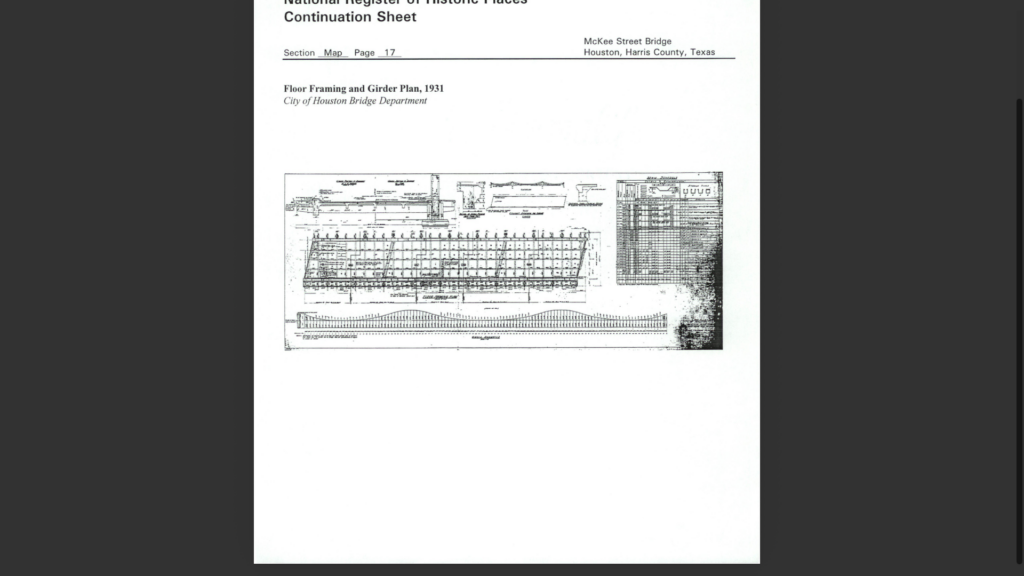
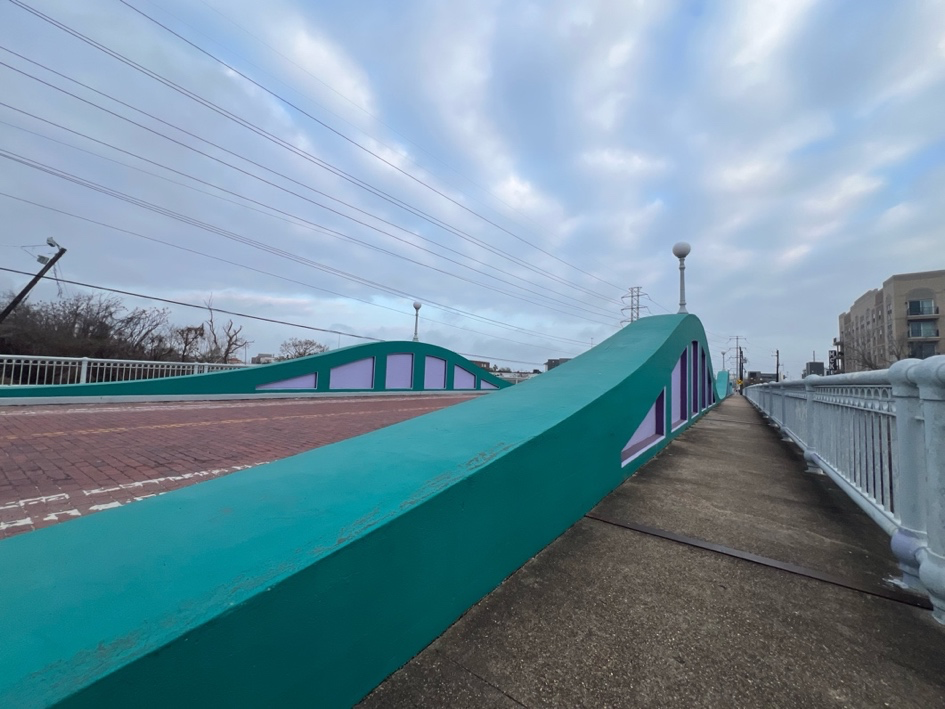
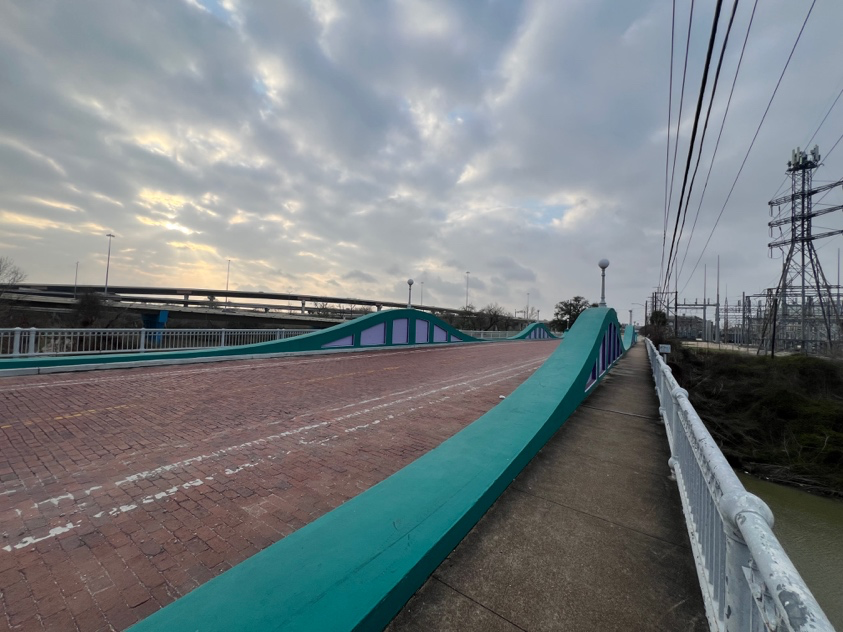
Reinforced concrete beams were already in common use by the early 1930s. However, the design practices of the time could not accommodate the 120-foot span required to provide the McKee Street Bridge’s 100-foot clear distance. That is where J.G. McKenzie’s solution proved so remarkable. McKenzie relied on a fundamental structural principle, providing resistance to force, in the most efficient way possible. Rather than forcing a conventional beam to perform beyond its limits, he shaped the exterior reinforced concrete edge girders to follow the curve of the moment diagram produced by the applied loads. In doing so, he created a beam whose form matched the forces acting upon it, allowing the structure to span the required distance with striking efficiency. The achievement becomes even more impressive when one considers the era in which it was built. Reinforcing steel existed, but it was far from the standardized material engineers rely on today.
The bars were square, largely nonstandard, and identified by their cross-sectional dimensions rather than by modern bar sizes. There were no sophisticated formwork systems or engineered methods for constructing curved concrete members. Instead, the shape of the girders was achieved through plywood forms, careful craftsmanship, and ingenious construction techniques. A contemporary account described the process, noting that “the heavy reinforcing along the tops of the girders was supported on adjustable steel hangers carried by 6 × 6-in. wood frames resting in the falsework.”3 McKenzie is quoted as saying, “We used all the mathematics at our command, and we finally arrived at this design. We wore out many a scratch pad and pencil before we were through.” 4
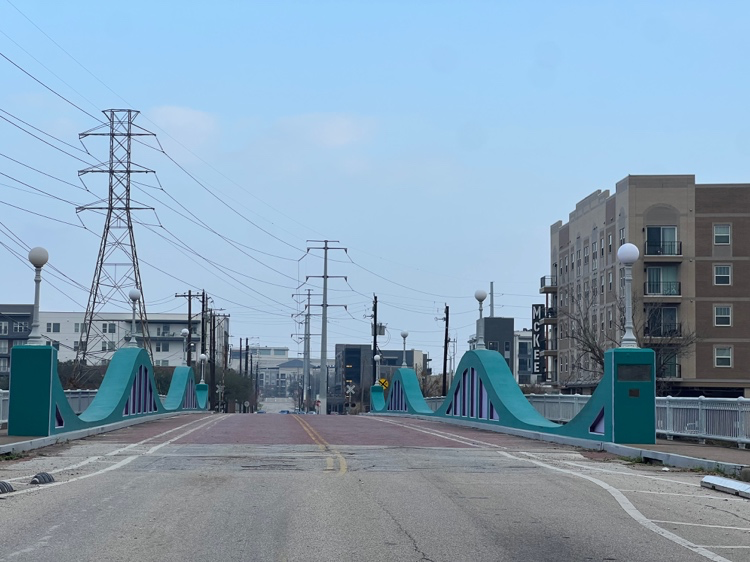
His design determination, along with the contractor’s dedication to quality craftsmanship, most certainly paid off. Almost a century later, the McKee Street Bridge stands as strong as ever, weathering today’s modern loadings with the same grace and style it displayed when it first opened in 1932. It also stands as a beacon of the integrity and commitment to knowledge that form the foundation on which today’s engineers build as they continue advancing the profession. For these reasons, the McKee Street Bridge was added to the National Register of Historic Places in 2002 and documented by the Library of Congress. As you drive through your city or hometown, how do you know you’ve arrived? What memories and stories stir in the back of your mind as the streets and landmarks pass before your eyes? These feelings are subtle, yet they anchor our sense of place. To forget where we come from is to forget who we are. The next time you have the chance, drive over the McKee Street Bridge. Tell its story. If you are a teacher, weave it into your curriculum. We cannot build a strong future without understanding the foundation beneath our feet.
Sources
1Houston Post, 3 April 1932.
2The North Side of Houston. (1932, April). The North Side Planning and Civics, 5(1), Unusual
3Hilborn, H. D. (1932, July 14). Girder contour marks new concrete bridge. Engineering News-
Record, 109(2), 36–37.
4TxDOT, “Survey of Non-truss structures,” 36