Historic Engineering Projects You Can Walk to in Downtown San Antonio
March 2026
Author: Angie Fealy PE
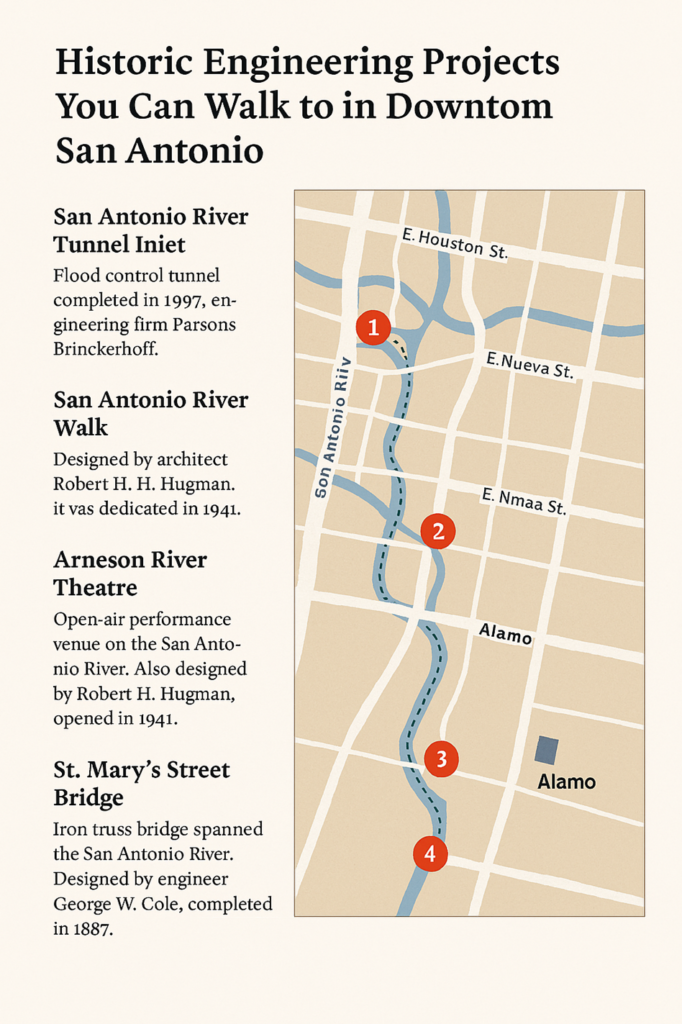
1. San Antonio River Tunnel Inlet
Designed by: Parsons Brinckerhoff; Completed: 1997
The San Antonio River Tunnel Inlet represents one of the most ambitious and transformative flood‑control efforts in the city’s history, serving as the northern entry point to the 3.1‑mile San Antonio River Flood Control Tunnel completed in 1997. Designed by the global engineering firm Parsons Brinckerhoff in collaboration with the U.S. Army Corps of Engineers and the San Antonio River Authority, the project emerged from decades of devastating floods that repeatedly overwhelmed the narrow, winding river channel downtown. Catastrophic events in 1913, 1921, and 1979 underscored the urgent need for a long‑term solution that could protect both residents and the increasingly vital River Walk. The tunnel inlet was engineered to capture and redirect massive volumes of stormwater, sending it deep underground to bypass the city center before rejoining the river farther south. Constructing such a system beneath a dense urban core posed significant challenges: engineers had to bore a large tunnel under hotels, historic structures, utilities, and the River Walk itself without disrupting daily life or damaging the fragile limestone geology beneath the city. The inlet also required sophisticated hydraulic modeling to manage high‑velocity flows, prevent erosion, and dissipate energy safely during major storms. Transitioning between layers of limestone, clay, and gravel added further complexity, demanding precision and constant monitoring. Protecting the River Walk during construction was equally critical, as even minor disruptions could have affected tourism and local businesses. Despite these challenges, the project succeeded in dramatically reducing flood risk while preserving the character and economic vitality of downtown San Antonio. Today, the River Tunnel Inlet stands as a quiet but essential piece of infrastructure—an engineering achievement that safeguards the city while remaining largely hidden in plain sight.
2. The San Antonio River Walk (Paseo del Rio)
Designed by: Robert H. H. Hugman, Completed: 1941
The River Walk is the crown jewel of San Antonio’s urban design. What began as a flood‑control initiative evolved into a visionary pedestrian network thanks to architect Robert H. H. Hugman, often called the “Father of the River Walk.” Hugman proposed a system of walkways, bridges, and commercial spaces that would transform the river from a hazard into a cultural and economic asset. His plan was realized in 1941, and later expansions turned the River Walk into one of the most visited destinations in Texas.
3. Arneson River Theatre
Designed by: Robert H. H. Hugman; Completed: 1941
The Arneson River Theatre is one of the most distinctive engineering and architectural achievements along the San Antonio River Walk, blending landscape, infrastructure, and performance space into a single cohesive design. Built between 1939 and 1941 as part of a Works Progress Administration (WPA) initiative, the theatre was designed under the supervision of architect Robert H. H. Hugman, widely known as the “Father of the River Walk.” Hugman envisioned a venue that would integrate the river itself into the performance experience, placing the stage on the north bank and the audience seating on the south bank, with the San Antonio River flowing directly between them. This innovative layout created a natural amphitheater that used the river as both a visual and acoustic element—something rarely attempted in American civic design at the time. The project was named after Edwin P. Arneson, the WPA regional engineer who played a crucial role in securing federal funding for the broader Paseo del Rio improvements, though he passed away before construction began. Transforming the site into a functional theater posed several challenges. The area had previously been used as a dumping ground for old vehicles and debris, requiring extensive clearing and stabilization before construction could begin. Engineers also had to design seating terraces that would withstand periodic flooding while maintaining comfortable sightlines across the river. Integrating the stage into the existing topography without disrupting the river’s flow demanded careful hydraulic consideration, especially given the city’s history of severe floods. Additionally, the WPA workforce—composed largely of young, inexperienced laborers—required on‑site training to execute Hugman’s detailed stonework and masonry designs. Despite these obstacles, the Arneson River Theatre emerged as a triumph of Depression‑era public works, combining engineering ingenuity with artistic vision. Today, it remains a beloved cultural landmark and a testament to San Antonio’s commitment to preserving and enhancing its riverfront heritage.
4. St. Mary’s Street Bridge
Designed by: George W. Cole; Completed: 1887
The St. Mary’s Street Bridge in San Antonio stands as a testament to 19th-century engineering and early 20th-century urban resilience. Originally constructed in 1890 by the Berlin Iron Bridge Company of East Berlin, Connecticut, the bridge was designed as an iron truss structure—a popular choice for its strength and modular assembly. It spanned the San Antonio River at St. Mary’s Street, serving as a vital crossing point in the city’s growing downtown. The bridge featured decorative ironwork and riveted joints, with a span of approximately 37 feet and a roadway width of 34 feet. However, the devastating flood of 1921 reshaped the city’s infrastructure priorities. Rather than demolish the aging bridge, city officials chose to relocate it to Brackenridge Park, preserving its historical and architectural value. This decision reflected a growing appreciation for adaptive reuse and historic preservation. In the late 1930s, the National Youth Administration—a New Deal-era program—undertook improvements to the bridge, reinforcing its structure and integrating it into the park’s landscape. These efforts were not without challenges: engineers had to stabilize the aging ironwork, adapt the bridge to its new setting, and maintain its original design integrity. Today, the St. Mary’s Street Bridge remains a beloved landmark near the Witte Museum, surrounded by other historic features like the Japanese Tea Garden and remnants of the city’s acequia system. It serves not only as a pedestrian crossing but also as a symbol of San Antonio’s layered history—where engineering, preservation, and civic pride intersect.