Hays Street Bridge: A Historic Engineering Landmark in San Antonio, Texas

By Melinda Luna, PE, CFM, F ASCE
The Hays Street Bridge is a significant historic civil engineering structures in Texas and stands as an enduring symbol of San Antonio’s industrial heritage. Originally constructed in 1881, the bridge has served multiple roles throughout its history—from an important railroad crossing to a beloved pedestrian landmark—and today represents a successful collaboration between engineering preservation and community revitalization. Its restoration demonstrates how historic infrastructure can continue serving the public while preserving an important chapter in the development of American civil engineering.
The bridge spans the Union Pacific railroad tracks just east of downtown San Antonio, connecting the Dignowity Hill Historic District with the Government Hill neighborhood. Although no longer used by trains, it remains a vital pedestrian and bicycle connection and is one of the city’s most recognizable historic engineering landmarks.
During the late nineteenth century, San Antonio experienced rapid growth as railroads transformed transportation throughout Texas. The Galveston, Harrisburg & San Antonio Railway required a safe crossing over an expanding network of rail lines near downtown. In 1881, the Hays Street Bridge was erected to provide that crossing.
The bridge is a classic example of a Whipple through truss, a design patented by renowned American engineer Squire Whipple, often referred to as the “Father of Iron Bridge Building” in the United States. Whipple’s truss system used diagonals that crossed two panels rather than one, allowing engineers to efficiently carry heavier railroad loads over longer spans than earlier bridge designs.
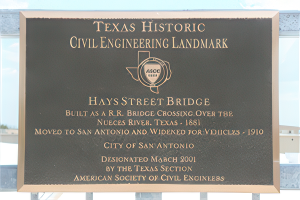
Although the bridge was originally constructed in 1881, the current steel truss spans were relocated to the Hays Street site around 1910 after previously serving another railroad crossing. Relocating bridge spans was common practice during this period, allowing railroads to reuse valuable structural steel while accommodating new transportation needs.
The Hays Street Bridge is notable for several engineering reasons.
First, it is one of the few remaining Whipple through truss bridges in Texas. During the late nineteenth and early twentieth centuries, this bridge type represented a major advancement in structural engineering. The design distributed loads efficiently through a network of compression members and tension rods, reducing material requirements while increasing strength.
The bridge’s riveted steel construction also illustrates the transition from wrought iron bridges of the nineteenth century to steel bridges that would dominate railroad construction during the twentieth century. The portal bracing, lattice members, vertical posts, and distinctive diagonal tension members remain excellent examples of early steel bridge engineering.
Another remarkable feature is the bridge’s longevity. Despite more than a century of service, much of its original structural framework remains intact following restoration, demonstrating the durability of early steel bridge construction when properly maintained.
By the late twentieth century, the bridge had fallen into disrepair after railroad operations ceased. Exposure to weather, lack of maintenance, and changing transportation patterns left the structure threatened with demolition.
Local preservationists, neighborhood organizations, engineers, historians, and civic leaders recognized the bridge’s historical and engineering importance. Their efforts ultimately led to a comprehensive preservation campaign that emphasized the bridge’s value as both a transportation structure and an important piece of San Antonio’s history. ASCE Texas Section member, Doug Steadman, PE lead the charge for the project.
Restoration included:
- Structural rehabilitation of the steel trusses
- Cleaning and repainting the bridge
- Repairing deteriorated members
- Installation of a modern pedestrian deck
- New lighting and safety railings
- Improved accessibility for pedestrians and cyclists
These improvements allowed the bridge to retain its historic appearance while meeting modern safety standards. The bridge was dedicated as a ASCE Texas Section Landmark in 2001.
Today, the Hays Street Bridge functions as a pedestrian and bicycle bridge rather than a railroad crossing. It forms an important connection between neighborhoods separated by extensive railroad infrastructure and provides spectacular views of downtown San Antonio.
The bridge has become a destination for photographers, cyclists, runners, and visitors interested in industrial history. Community events, educational tours, and historical programs frequently highlight the bridge as an example of successful infrastructure preservation.
Rather than viewing historic bridges as obsolete, the Hays Street Bridge demonstrates how adaptive reuse can extend the life of significant engineering structures while creating valuable public spaces.
The Hays Street Bridge represents several important themes in the history of civil engineering:
- The expansion of the American railroad network during the nineteenth century.
- The evolution of steel bridge design.
- The work of pioneering bridge engineer Squire Whipple.
- The durability of riveted steel truss construction.
- The growing importance of historic preservation within the engineering profession.

These qualities make the bridge an excellent example of why the American Society of Civil Engineers recognizes and promotes the preservation of historically significant engineering works. Historic structures such as the Hays Street Bridge illustrate the ingenuity of earlier generations of engineers while providing valuable educational opportunities for today’s professionals and students.
More than 140 years after its original construction, the Hays Street Bridge continues to serve San Antonio in a new capacity. Its preservation demonstrates that historic infrastructure can remain both functional and meaningful long after its original purpose has changed.
The Hays Street Bridge exemplifies the importance of preserving engineering achievements that have shaped the state’s development. It tells the story of railroad expansion, innovative structural design, and the enduring value of thoughtful engineering. As both a transportation landmark and a community gathering place, the bridge remains a testament to the lasting impact of civil engineers on the built environment and serves as an inspiring reminder that preserving our engineering heritage enriches both present and future generations.
Holth, N. (2019, August 6). Hays Street Bridge (Bridge documented 2012 and August 6, 2019). HistoricBridges.org. historicbridges.org