First City Engineers in Texas
December 2025
Author: Melinda Luna PE
A City Engineer is responsible for the design, construction, and maintenance of public infrastructure within a city or municipality. This includes roads, bridges, water and sewer systems, and public buildings. City Engineers also play a critical role in the development of new communities and neighborhoods by ensuring the infrastructure can support future growth. In addition to technical responsibilities, they manage project budgets, ensure timely completion, and coordinate with various stakeholders, including elected officials, other municipal departments, and the general public.
While not all cities or municipalities have a dedicated City Engineer today, it raises an interesting historical question: Which Texas city was the first to appoint a City Engineer, and were their responsibilities similar to those of modern engineers?
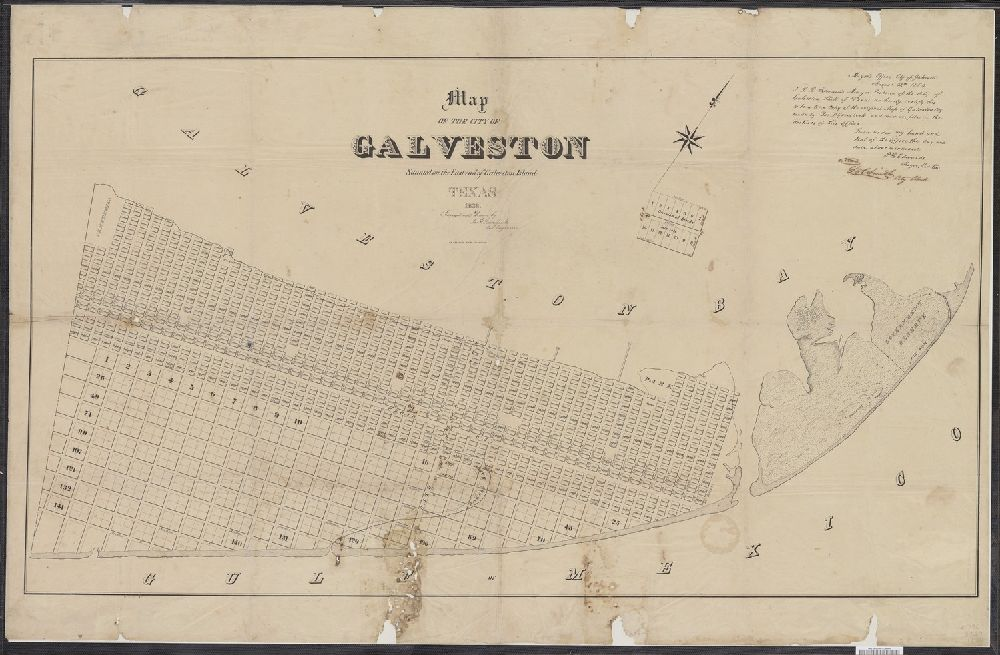
When Texas gained independence in 1836 and became a state in 1845, there were no local universities to train civil engineers for municipal roles. At that time, the oldest towns included Galveston, Nacogdoches, San Antonio, Dallas, San Augustine, Austin, and Presidio. Among these, Galveston, then the most populous city in Texas, was the first to appoint a full-time City Engineer: John D. Groesbeck.
Groesbeck was hired to lay out the city’s infrastructure. His initial tasks included establishing a pier for the Texas Navy at the foot of 24th Street and creating a public square on what was formerly a camping ground, later named Central Park. He surveyed the city and designed the street plan, modeling it after Philadelphia, with long avenues running parallel to the Gulf and numbered cross streets. Between 1837 and 1840, Groesbeck led several civic projects while also operating a store and a newspaper in Galveston. He later served as an alderman in Galveston before moving to San Antonio, where he supplied Fort Sam Houston and again served as alderman (in 1849 and 1855). His San Antonio home, located along the river, hosted many notable figures, including Robert E. Lee, Sam Houston, Mirabeau B. Lamar, and Prince Carl of Solms-Braunfels.
The second Texas city to appoint a full-time City Engineer was San Antonio, which hired François P. Giraud. Educated in Maryland and Paris, Giraud served as City Engineer from 1849 to 1853. His contributions included surveying the boundaries of the San Antonio missions and working on architectural plans for St. Mary’s University, Ursuline Academy, and San Fernando Cathedral. He also prepared designs for San Pedro Park, the Alazán Creek system, and irrigation channels. Giraud later served as alderman (1857–1858) and eventually became mayor from 1872 to 1875. A forward-thinker, he advocated for the city to preserve land around the San Antonio Springs, recognizing the long-term importance of water resources.
Other Texas cities would eventually follow Galveston and San Antonio in hiring City Engineers to develop and maintain critical infrastructure. There’s no centralized record of every City Engineer in Texas, so it’s unclear exactly how many municipalities have such a position today. According to the Texas Board of Professional Engineers, 1,496 licensed engineers list a city as their employer. However, with 1,225 municipalities in the state, it’s evident that not all have City Engineers.
Over time, the role of the City Engineer has evolved. In addition to traditional responsibilities, modern engineers now focus on sustainability, climate resiliency, and environmental stewardship—ensuring that the infrastructure built today meets the needs of tomorrow.