Evolution and Standardization of the Yield Sign in U.S. Traffic Control
March 2026
Author: Melinda Luna PE, CFM, F.ASCE
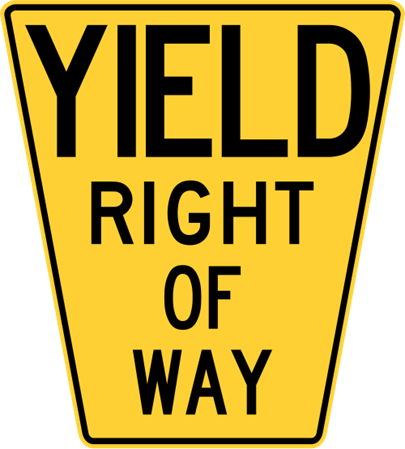
In the context of highway traffic control, the yield sign is defined as a regulatory device that instructs a driver to slow down and be prepared to stop when necessary to allow vehicles or pedestrians with the right-of-way to proceed first. A complete stop is required only if conflicting traffic or pedestrian movements are present. This distinguishes yield control from negative control devices such as stop signs, where a full stop is mandatory irrespective of conflicting traffic.
The earliest documented use of a yield sign in the United States occurred in 1950 at the intersection of First Street and Columbia Avenue in Tulsa, Oklahoma. This location was identified as a high accident frequency site, prompting local traffic enforcement to explore alternative right-of-way control measures. Clinton E. Riggs, then a captain in the Tulsa Police Department, is credited with the conceptual design and installation of the original yield sign. The device was intended to clarify right-of-way obligations and to create a basis for liability assignment in collisions at uncontrolled intersections.
The original yield sign featured:
- A keystone silhouette (wider at the top, narrowing toward the base),
- A high-visibility yellow background (selected due to nighttime conspicuity in the absence of retroreflective materials),
- Bold black text reading “Yield Right of Way.”
Empirical observations following installation indicated a significant reduction in crash frequency at the treatment site within one year. The local success catalyzed adoption in surrounding municipalities.
Following localized success, the Manual on Uniform Traffic Control Devices (MUTCD) incorporated the yield sign into national practice in 1954. Early national designs retained a black legend on a yellow inverted equilateral triangle, with the legend “YIELD RIGHT-OF-WAY,” serving as a standardized device for controlling right-of-way at less restrictive junctions.
The MUTCD revisions reflected ongoing refinements:
- 1961 Edition: simplified the legend to “YIELD” to improve comprehension and reduce sign clutter.
- 1971 Revision: introduced the modern red border and white background with red lettering configuration still in use today, aligning yield sign color schemes with other high-visibility regulatory signs and improving nighttime conspicuity.
The yield sign operates within the context of right-of-way law, which already existed in statute prior to its invention. The sign’s functional intent is to reduce conflict points at intersections where the traffic volume or sight distance does not justify a full stop, yet a regulatory message is necessary to govern driver behavior. This results in improved operational efficiency and reduced stopping delay, without sacrificing safety for unprotected movements.
According to MUTCD and supplemental state manuals (e.g., 1954 Georgia manual), the equilateral triangle shape with the apex pointing downward was specifically allocated to yield signs to ensure instant recognizability across varying environmental conditions and to distinguish them from other traffic control devices.
Over approximately two decades, the yield sign in the United States evolved from an experimental local prototype to a nationally standardized regulatory device widely recognized in traffic engineering practice. Its development underscores an early example of field-driven innovation subsequently codified through uniform standards, illustrating the iterative process by which traffic control devices mature from localized solutions to national norms.
References
- Riggs, C. E., “Original Yield Sign Implementation, Tulsa, 1950,” documented in multiple historical sources.
- Yield sign history and design evolution, summarized from historical accounts of original sign characteristics and adoption.
- MUTCD revisions and yield sign standardization (1954, 1961, 1971).
- Georgia Manual on Uniform Traffic Control Devices (1954) designations for yield sign shape and right-of-way message.
- General historical compilation on yield sign origin and international context.